Mail filters hunt for links. The Geek Squad invoice scam email gives them nothing to hunt: no link, no login page, just a bill and a phone number. A number is plain text, so the message sails past scanners and lands looking like routine billing. The caller does the real work later. Here is how the trick runs, what it has cost, and the one check that ends it.
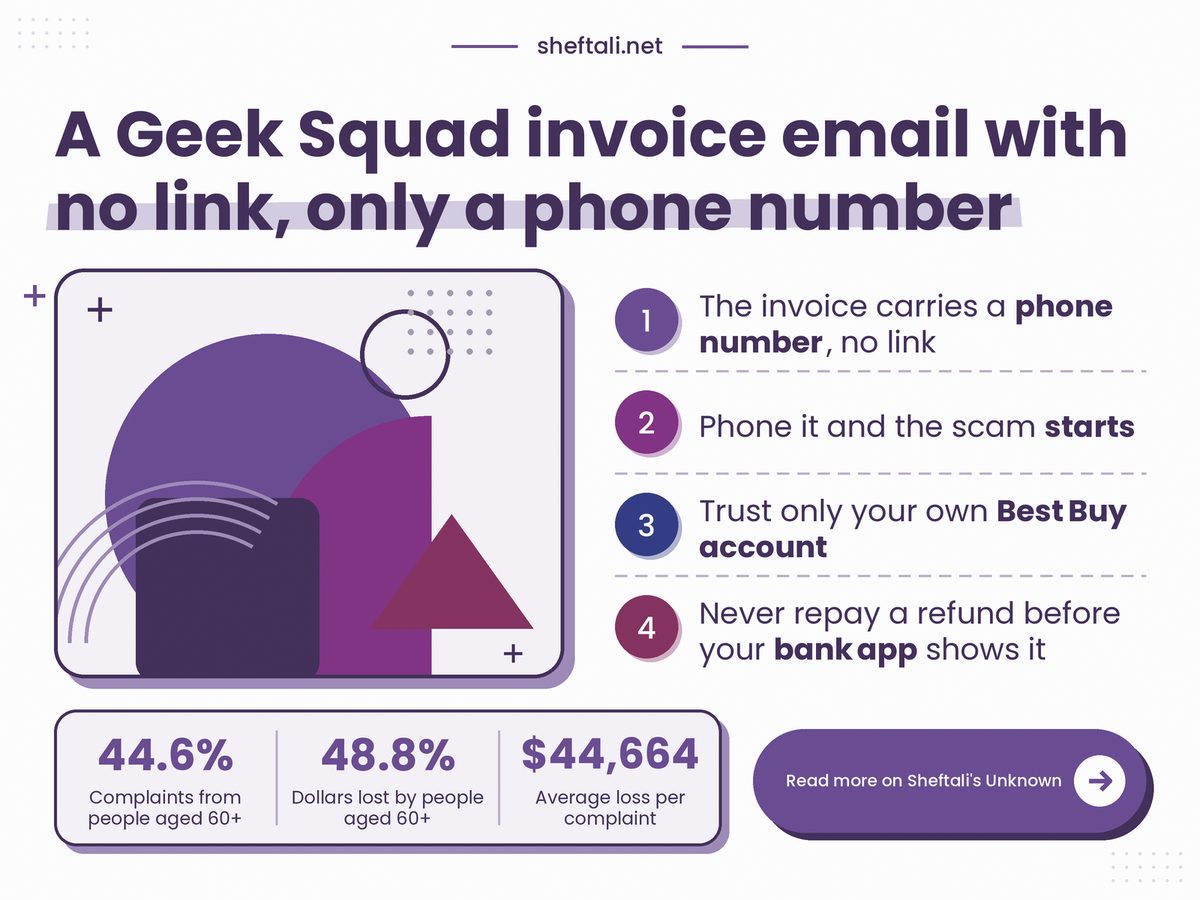
A Geek Squad invoice email that tells you to phone a number is a scam until your own Best Buy account lists the charge.
- The message has no link on purpose: with nothing to scan, filters let it through and the phone number does the work.
- Losses in this fraud category grew faster than complaints, so the typical case now costs more.
- Never repay a "mistaken refund" before your bank app shows money actually arrived.
Why does a Geek Squad invoice scam email carry no link?
A link is the one thing a mail filter can scan and block, so the scam hides its payload in a phone number, which reads as harmless text and only turns dangerous when you dial it.
Researchers Joshua Long and Kirk McElhearn documented the mechanism at Intego in April 2023. The emails came from a sender named "Intuit E-Commerce Service", relayed through Intuit's own invoicing servers, which spam filters tend to trust. The subject read like a receipt for a three-year Totaltech renewal. So "it came from a real invoicing service" proves nothing, and the standard advice to inspect the sender address no longer settles it. That advice is outdated for this scam. The pattern echoes a toll-text scam that gates its link behind a reply and a fake renewal invoice with an extra-zero refund trap.
The FBI's Internet Crime Complaint Center shows the scale. Its 2024 report logged 36,002 tech and customer-support complaints and $1.46 billion lost. Its 2025 report logged 47,794 and $2.13 billion. Complaints rose 32.8% while losses rose 45.7%, so the average case got costlier, not just more common. Neither report states that comparison; we derived it by setting the two side by side.
Four numbers decide how seriously to take this. The FTC's October 2022 alert supplies the clock, and IC3's 2025 report supplies the rest, with two of them derived by dividing its totals rather than read off a page.
Time Allowed to Call
24 hours
Stops you checking first
Average Loss per Complaint
$44,664
Derived: losses divided by complaints
Extra Complaints in One Year
11,792
Derived: 2025 minus 2024
Share of All Reported Losses
10.2%
About one dollar in ten
The deadline matters more than the money. A message that demands a call within a day exists to stop you doing the one slow, boring thing that would expose it: opening your own account. Urgency is the product being sold.
The number in the message is the only payload. Leave it undialled and the scam has nothing left to run.
Is a Geek Squad invoice email real?
Not on the evidence in the email itself: an invoice proves nothing about whether a charge exists, because anyone can send one through a trusted billing service, so proof has to come from somewhere the sender does not control.
The table sorts the situations by what you have already done. Find your row; the last column carries the fact that decides it. Where a rule comes from the FTC, the row says so.
| If you | Do this | Because |
|---|---|---|
| Unknown invoice | Check your own Best Buy account | No plan listed means $0 to renew |
| Renewal notice | Ignore the number; read your plan page | Intego's 2023 sample read $199.99 |
| Already called | Hang up, block, watch statements | FTC: callers ask for screen access |
| Repay demanded | Pay $0 until your bank app shows funds | Repay = claimed refund minus invoice |
| Gift cards asked | End the call; report to FTC | Gift-card repayment is an FTC red flag |
The common thread is order. The scam needs you to act before you look, so every row puts a look at your own accounts first. The repay row costs real money, and older people meet it more often than their numbers suggest.
Decision: whether an older relative needs this check set up for them before the call comes, since the outer ring shows their share of dollars lost outrunning their share of complaints. Derived by dividing IC3's 2025 age-group totals for people over 60 by its tech and customer-support totals.
Worked example: suppose the email claims a $300 renewal, and the caller says a $5,000 refund landed by mistake. Both figures are illustrative assumptions, not sourced numbers. Repay demanded: $5,000 minus $300 is $4,700. Now open your bank app, a one-minute check that is yours alone to make. If nothing landed, you are asked to send $4,700 against $0 received, so paying costs exactly $4,700. Move the sliders to the three figures in your own situation.
Why did I get an invoice for something I never bought?
Because the sender does not need you to be a customer: a bulk invoice only has to reach the few people who own a plan or fear one lapsed, and everyone else is free noise.
The FTC's alert lays out the escalation. After the call can come a request for remote access, then a story that you were "accidentally refunded too much", then a demand to repay with gift cards. Each step makes the last one harder to walk away from, which is why the first call is the one to skip.
Reports from people over 60 rose 27.2% on 2024 while their losses rose only 5.9%, so the average hit per report fell, though at $48,785 it still sits about 9% above the all-age average. Our opinion, not a finding: IC3 counts only those who file, and we suspect embarrassment keeps many victims out of the totals. Report the message at ReportFraud.ftc.gov. Delete it, or rather report it first, then delete it.
- A valid software signature says who built the support tool, not who is holding it. Intego's caller steered its author to an app signed by ConnectWise.
- A callback number that changes mid-call is a warning. Intego's follow-up number routed to a TextNow voicemail.
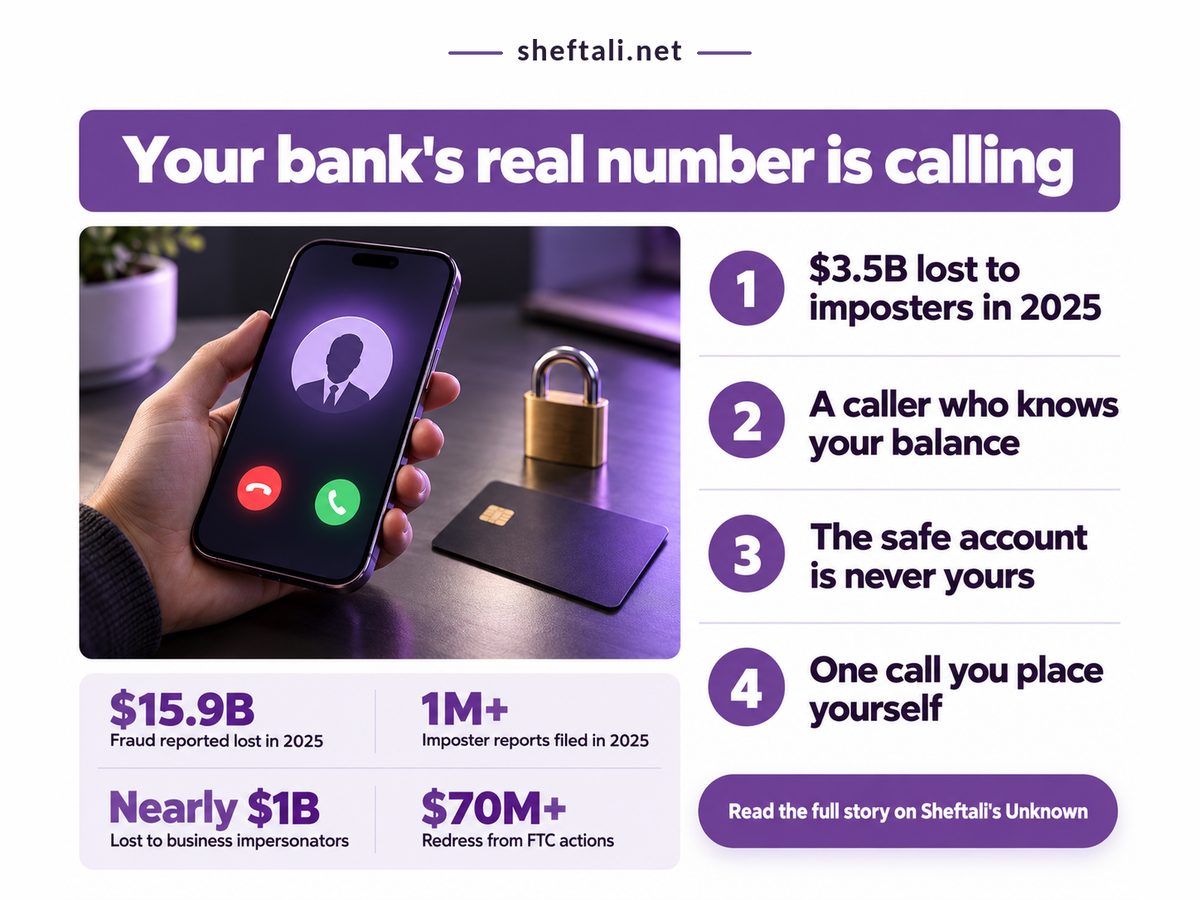
- The same trick works by phone: a fake bank fraud call can show your real bank's number, so a familiar caller ID settles nothing.
Key Takeaways to act on: check these about your own situation
- You cannot find the charge or plan in your own Best Buy account history.
- The only way offered to dispute it is a phone number printed in the message.
- The caller opens with a refund you never saw land in your bank app.
- Anyone asks you to install a support app, share your screen or buy gift cards.
This week, type the Best Buy address into your browser yourself, sign in to your own Best Buy account, read the plans and charges it lists, and treat the invoice as unproven until they match. Then walk the relative who would pick up that phone through the same two minutes. One limit: this checks the charge, not your bank, so if you already paid or gave screen access, call the number on the back of your card.
How we checked this
We read the FBI IC3 2025 Internet Crime Report (2026), the FTC consumer alert of 25 October 2022 and Intego's analysis of 13 April 2023. We derived the year comparison, the shares and the worked example ourselves, on the assumptions stated there. No product was tested hands-on for this article, and Intego describes how the scam ran in 2023, not today.
Last verified: 26 October 2026. Edited by Sheftali, reviewed after publication. Spotted something out of date? Tell us and we will correct it.